From WordPress shop to Nuxt agency
We didn't pick Nuxt because it was trendy. We grew into it - through Vue, through thousands of hours of client work, and eventually into an Official Nuxt Partner badge. Here's how that happened, and why it matters for your project.
In the beginning, Coditive was a WordPress company. We never planned to call ourselves a Nuxt agency - the term didn’t even exist yet. But as our projects grew more ambitious, we kept hitting the same wall: clients wanted interactivity that traditional WordPress themes weren’t built to deliver.
That’s what led us to Vue.js. Its learning curve was friendly, its footprint small, and it slotted into our existing WordPress work instead of replacing it. We started pairing Vue frontends with WordPress backends: real-time features without page reloads, smoother transitions, and noticeably faster interfaces - all while keeping the content management our clients already knew. We were giving conference talks about that combination back when it still raised eyebrows in the WordPress community.
After Vue, Nuxt was the natural next step. It gave us server-side rendering, stronger SEO, and a structured way of building that scaled across a team. What started as “Vue with extras” eventually carried entire projects that didn’t involve WordPress at all.

Today we’re an Official Nuxt Partner - a recognition that comes from shipped work, not a submitted form. If you want the service details rather than the story, they live on our Nuxt development services page.
Why we bet on Nuxt
One framework, every rendering strategy
The first thing Nuxt fixed for us was the rendering question. Classic single-page apps render in the browser, which means search engines and slow connections get a blank page first and content later. Nuxt lets us choose per project - and even per page: server-side rendering for content that must load fast and rank, static generation for sites that rarely change, client-side rendering for highly interactive areas, and hybrid setups that mix all three.
That flexibility is the practical difference between Nuxt and plain Vue or React. We stopped forcing one rendering model onto every project and started matching the strategy to the job.
SEO, social - and now AI search
Server-rendered pages give Google complete content to crawl instead of an empty shell waiting for JavaScript. The same property fixes social sharing: Facebook and LinkedIn read your metadata correctly, so shared links get proper previews with the right image and title.
In 2026 there’s a third reader that matters: AI. ChatGPT, Gemini, and Perplexity recommend businesses whose sites they can parse, and server-rendered, well-structured Nuxt output is exactly what they parse best. We’ve audited sites that were invisible to AI search purely because of how they rendered - it’s a real problem with a technical fix. (If that topic is your problem, our AI services page goes deeper.)
A developer experience that clients feel
Nuxt is opinionated in the useful way: automatic routing, code-splitting, TypeScript support out of the box, and hot module replacement that makes changes visible in milliseconds. Nitro, its server engine, cut our deployment times to seconds. Nuxt Layers let us share proven code between projects instead of rebuilding the same foundations.
None of that is visible to you as a client - but you feel it. Less time spent on configuration is more time spent on your features, which shows up as faster delivery and a smaller invoice.
Modules that skip the boilerplate
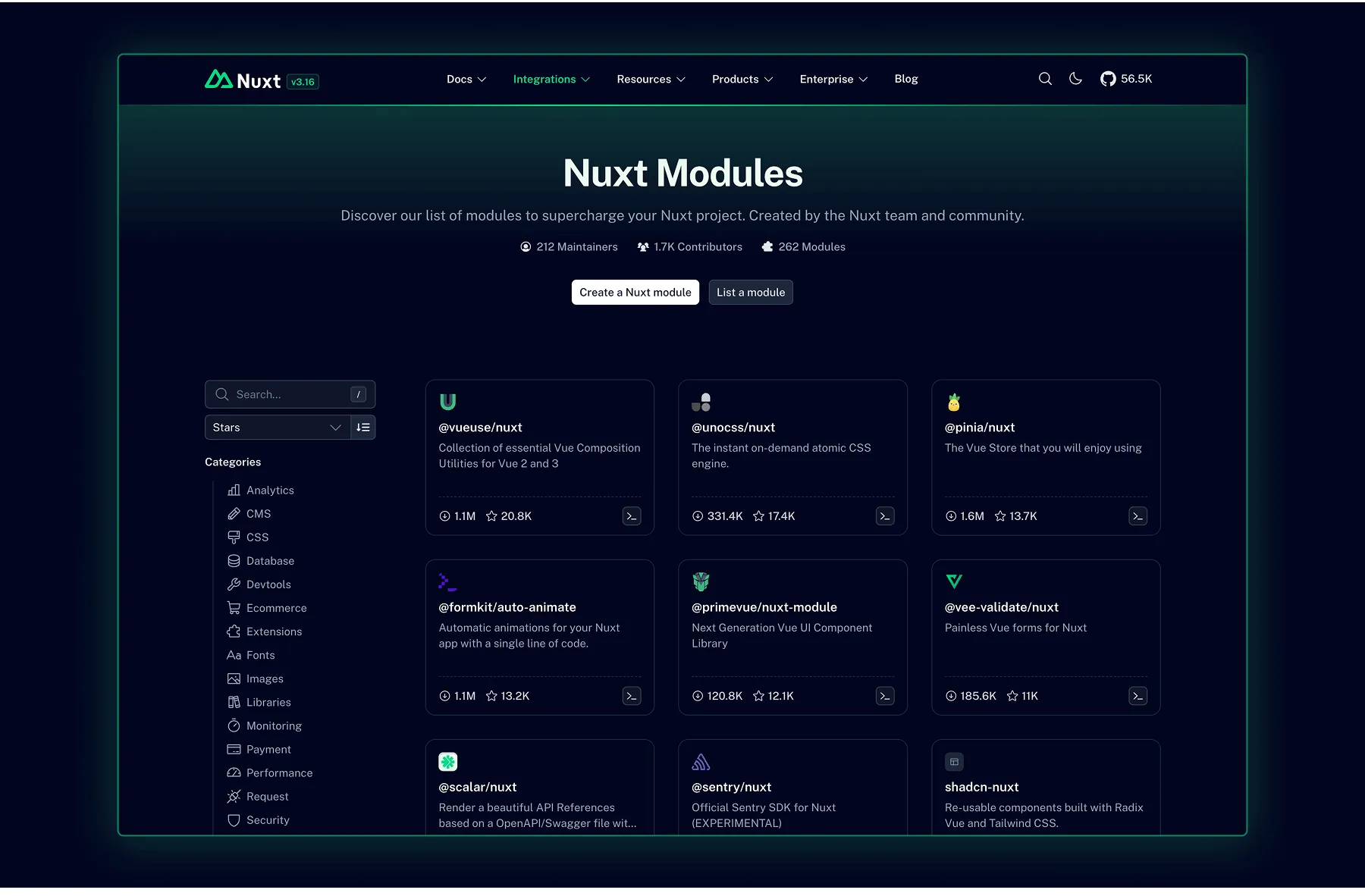
The Nuxt module ecosystem handles the recurring work: Nuxt SEO wires up search best practices, Nuxt Content turns a folder of Markdown into a content management system, Nuxt Image optimizes every image automatically. We lean on these where they fit so the custom work in your budget goes toward things that are actually custom.
Projects that made us a Nuxt agency
Much of our Nuxt work ships white-label under NDA, so we can’t show everything. Here are the ones we can name.
Whatagraph - marketing reporting platform
Whatagraph collects, organizes, and visualizes marketing data from dozens of integrations. Their website runs on Nuxt, Strapi, and Tailwind, and it’s one of our longest-running engagements - we ship improvements monthly. We also carried their codebase through a full Nuxt 2 to Nuxt 3 migration, which we wrote up on the blog: Nuxt 2 to Nuxt 3 migration - why now and how to succeed.
Anika.vet - veterinary practice website
Most of our team works from home offices with pets photobombing the meetings, so a veterinarian’s website was an easy project to love. Anika.vet is built with Vue, Nuxt, Nuxt Content, and Nuxt Studio - a clean example of how we handle content-focused sites with a modern stack.
Enterprise social media screening platform
For a US background-screening company we built a system that analyzes public social media profiles against defined conditions - Vue and Nuxt on the front, Node.js with Express, Socket.IO, and Puppeteer behind it. It’s the project we point to when someone asks whether Nuxt can handle complex data processing. It can.
Pragmate.dev - our developer blog
Pragmate.dev is where our team publishes technical insights and coding tips, built on Nuxt Content. It’s also proof of an old habit: we share what we learn, at local events and online, because the Vue ecosystem gave us a lot before we had anything to give back.
Working with us
If you’re looking for a Nuxt agency, the practical next step is simple: read through what we offer, look at our projects, and then tell us about yours. We’ll respond with an honest assessment of scope, timeline, and cost - usually within one business day.